
The Ultimate Guide to Identifying Authentic Pure Pashmina Shawls
Apr

Introduction: The Looming Question of Authenticity
A pure Kashmiri Pashmina shawl is more than a winter accessory; it is an heirloom, a piece of wearable art, and a testament to centuries of Himalayan craftsmanship. Worn by royalty across the globe, its reputation for weightless warmth is unmatched. However, this global demand has created a saturated market overflowing with synthetic knock-offs, blended fabrics, and falsely labeled “viscose Pashminas.”
When you are investing in luxury handloom textiles, the fear of purchasing a counterfeit is genuine. How can you, as a buyer, distinguish between a mass-produced factory scarf and a hand-spun, hand-woven masterpiece crafted by a seasoned Kashmiri artisan?
In this comprehensive guide, we will break down the science, history, and sensory tests required to identify genuine Pashmina. By the end of this article, you will have the knowledge to confidently invest in an authentic piece from collections like those curated at 3jar.com.
Section 1: What Exactly is True Pashmina?
Before testing for authenticity, we must define the material. The word “Pashmina” translates to “soft gold” in Persian. It refers specifically to the fine undercoat hair of the Capra Hircus goat, natively known as the Changthangi goat.
The Geographic Exclusivity
These goats survive in the freezing, high-altitude deserts of the Changthang region in Ladakh, at elevations above 14,000 feet. To endure winter temperatures that drop to -40°C, the goats grow a remarkably fine, insulating undercoat. Come spring, they naturally shed this coat by rubbing against rocks and shrubs.
The Micron Magic
Human hair has a thickness of about 70 to 100 microns. A standard sheep’s wool strand is about 24 microns. Authentic Pashmina wool boasts a staggering fineness of 12 to 16 microns. Because the fiber is so incredibly thin and fragile, it cannot be spun by heavy industrial machinery without breaking. True Pashmina must be gathered, cleaned, spun on a traditional Charkha (spinning wheel), and woven on handlooms by master craftsmen in Kashmir. This laborious, manual process is what dictates its premium value.
Section 2: The 5 Foolproof Tests for Authentic Pashmina
If you have a shawl in hand, or are carefully reviewing high-resolution product galleries, here are the tests to determine its authenticity.
1. The Visual Test: Look for the Weave (The Irregularity Factor)
Perfection is the hallmark of a machine; slight imperfection is the signature of a human hand. Hold the shawl up to the light.
Fake: A machine-made synthetic shawl will have a perfectly uniform, tight, and flawless weave.
Authentic: A genuine handloomed Pashmina will have a very subtle, uneven weave when viewed closely against the light. Because it is woven by hand, the tension of the threads varies slightly.
2. The Touch Test: The “Pilling” Reality
There is a common misconception that high-quality luxury wool does not pill. This is false.
Because Pashmina fibers are a natural animal byproduct, friction will cause small, microscopic balls of fluff (pilling) to form on the surface after initial use. If a seller promises a “100% pill-free Pashmina,” they are likely selling a synthetic polyester or nylon blend.
3. The Ring Test: A Cautionary Tale
The famous “Ring Test” suggests that an entire pure Pashmina shawl can pass seamlessly through a standard-sized finger ring. While this is generally true for plain, lightweight Pashmina wraps, it is not a definitive test.
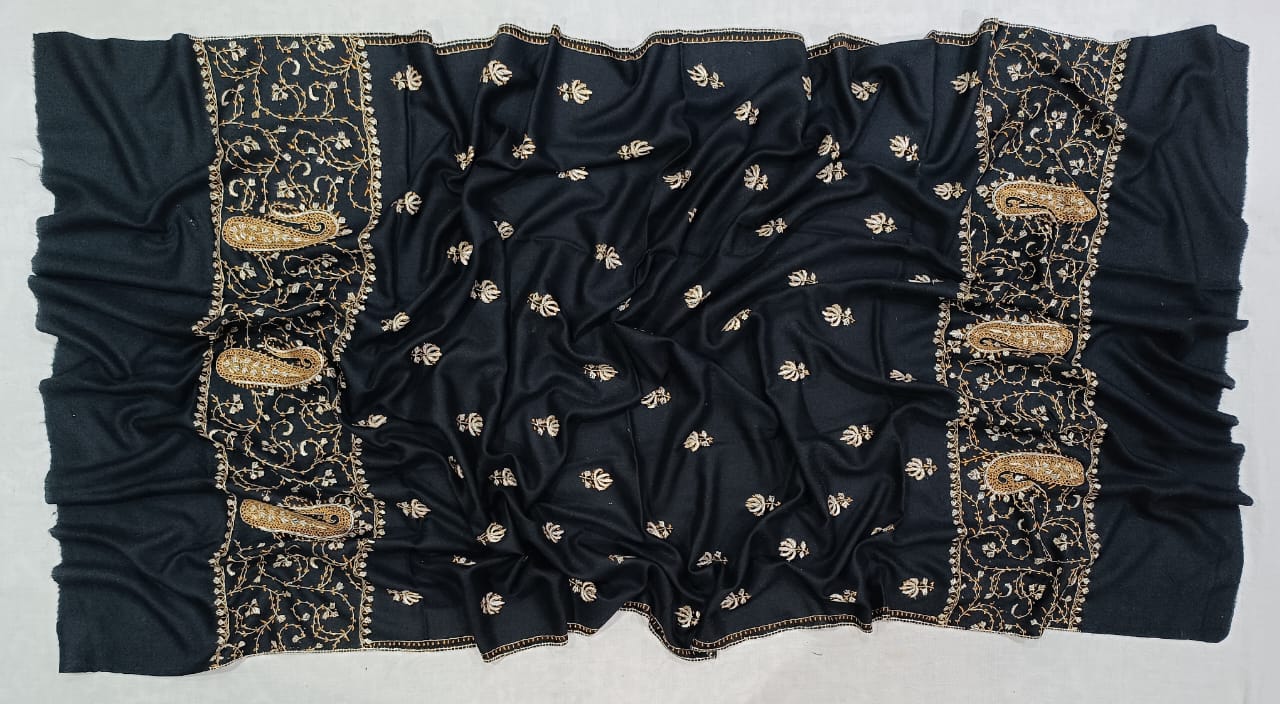
Many modern factories produce synthetic viscose scarves treated with chemical softeners that can also slide through a ring. Furthermore, an authentic Pashmina shawl featuring heavy Aari or Sozni embroidery will not pass through a ring due to the added thickness of the silk or cotton threads. Use the ring test only as a secondary confirmation, never as your primary deciding factor.
4. The Burn Test (Proceed with Caution)
If you own a shawl and are willing to sacrifice a single tiny fringe thread, the burn test is highly accurate.
The Method: Isolate one thread and light it with a match.
The Result: Because Pashmina is natural hair, it will smell exactly like burning hair or burnt feathers. The ash left behind will be a powdery, crumbly residue.
The Fake Result: If it smells like burning plastic, leaves a hard synthetic bead, or catches fire like paper, it is a synthetic or cotton blend.
5. The Static Test
Rub the fabric vigorously against itself in a dark room.
If it creates small sparks or a crackling static sound, it contains synthetic fibers like acrylic or polyester. Natural animal hair like pure Pashmina does not generate static electricity.
Section 3: The Importance of the GI Tag
To protect the heritage of Kashmiri artisans and combat the flood of counterfeits, the Government of India introduced the Geographical Indication (GI) Tag for Kashmir Pashmina.
A GI-tagged Pashmina shawl guarantees three things:
The yarn is 100% pure Pashmina obtained from the Changthangi goat.
The yarn is hand-spun.
The fabric is hand-woven on traditional looms entirely within the geographical borders of the Kashmir valley.
When shopping online, look for platforms that transparently discuss their sourcing and support GI-tagged products or direct artisan procurement.
Section 4: Shopping Securely at 3jar.com
Understanding the value of genuine craftsmanship is only half the battle; the other half is finding a secure, trustworthy platform to make your purchase. At 3jar.com, we bridge the gap between authentic Kashmiri artisans and a global audience.
When you order a premium shawl or traditional garment from our online shop, you are guaranteed a seamless and secure experience:
Transparent Delivery: Standard orders take 5-14 business days, securely packaged to protect delicate fibers. Delivery is a flat ₹150, but we offer free shipping on all carts above ₹5000.
Secure Transactions: Your data is protected by industry-standard SSL encryption. We accept all major cards, net banking, and instant UPI payments for your convenience.
Direct from the Source: By focusing on regional goods and promoting traditional Kashmiri craftsmanship, our catalog ensures that the art of the Valley is delivered directly to your doorstep.